Photo credit – John Macfarlane
AUTUMN UPDATE – 2023
- We had our inaugural MBOG meeting at LVH on 26 September – thank you to all who attended, and sorry that some of you were unable to come. Hopefully this update will bring you up to speed.
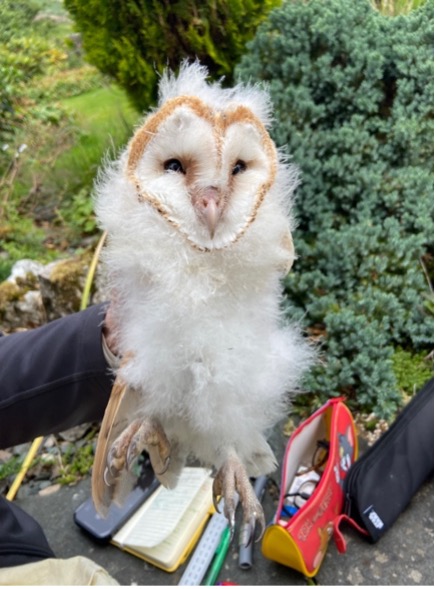
- Good news all round – reports from across the valley this summer show a nice spread of Barn Owls (better than we expected), and we know of five successful clutches. The owlets in those clutches were all ringed; three of them consisted of five owlets each, and the other two had three owlets (at the time of ringing).
- One area we’re less clear on though is Lorton – no reports of Barn Owls around the village, but we don’t know if that’s because they’re not being seen, or don’t exist in the area. We do know there are Tawny Owls, and the two don’t always happily co-exist, although they do in other parts of the valley.
- If buying or building a nest box, please make sure it is built to the correct design (see the Barn Owl Trust website, which also has lots of useful information on the next points, and others too).
- The key things we can do to encourage and preserve the presence of Barn Owls in our area are:
- Preserve existing nest sites and provide new ones;
- Encourage rough pasture;
- Think about cattle and other water holders which put Barn Owls at risk of drowning;
- Use less rat poison.
- We have a number of action points, including siting more nest boxes in the valley and spreading the word about the above things that we and landwoners can do.
- Last but not least, please keep reporting sightings to me – hfdrann@gmail.com (and any other thoughts / ideas also gratefully received).
Article about Barn Owls which appeared in The Link, October 2023
Nature Notes – Barn Owls
I once read a book about owls which said that the northern parts of this country are “too cold, too wet and too blowy to be comfortable for the delicate, warmth-loving Barn Owl”. Fortunately, this doesn’t seem to include the Melbreak Communities area – I’ve been happy to learn of five successful breeding pairs locally this year, three of which had a clutch of five owlets. Something must be right, but there’s also more we can do, and we have a Melbreak Barn Owl Group working together on this.
Seeing a hunting barn owl, flying ghost-like over the grass, is a magical thing. Despite appearances they are very slight under their feathers; most adults weigh only about 300-360g. My book was right, in that the barn owl’s feathers, specially adapted so they can fly silently, are not particularly waterproof and they cannot store a lot of fat. Their diet is mainly field voles, but also shrews and mice. An adult will usually eat 3-4 prey items a night, so during the breeding season a pair need to find this amount for themselves, as well as for their off-spring. For our local clutches of five owlets, that was 21-28 rodents a night. Rough grassland is where small mammals thrive; we have an abundance of that already, but any opportunities to provide more will always help.
Barn owls have a large ‘home range’ – they are very site faithful and will stay in their own range all their lives; ranges can overlap with that of other barn owls. Outside the breeding season the range is about a 4km radius around their nest (5,000 hectares) but this shrinks when there are more mouths to feed, to about 1km. Within that home range a pair will generally use one or two nest sites, 1-3 roost sites, and other sites which they visit occasionally. At least one owl I know of in the area continued to use the nesting box throughout last winter. Loss of nesting sites is a problem for the species, but can be mitigated by erecting a nestbox, although it’s important to build and site it correctly. Between August and the end of November (i.e. now), juvenile barn owls disperse, usually away from their parents’ home range.
Sadly, most barn owls die young, with starvation being the main cause of mortality. The average life expectancy of an owl which reaches 5 weeks old (many die before even leaving the nest) is just 18 months. With sufficient food and no disasters, a barn owl could usually be expected to live to about 4 years old. Particular hazards include drowning in cattle water troughs, eating prey which has been poisoned, flying into overhead wires, and being hit by road vehicles (unfortunately they are designed to fly low, and often hunt on road verges).
The Barn Owl Trust website is an excellent resource for more information.
Harriet Davies
Melbreak Barn Owl Group is a Melbreak Wildlife Group initiative, supported by The Melbreak Communities.
 The Melbreak Communities