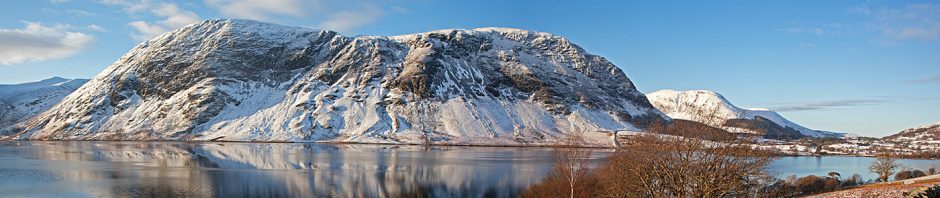
There are two possible origins for the name Buttermere, according to the entry on the Wikipedia website. First, that it is derived from the Old English “butere mere” – “the lake by the dairy pastures”; second that it is a corrupt form of a personal name “Buthar”, as in “Buthar’s mere” (lake). Local tradition has it that the valley of Buttermere was part of the holdings of an 11th century Norse chieftan called “Buthar”, sometimes spelt “Boethar”.
The famous Honister Blue slate mines on Honister Cragg, which forms the south side of the narrow Gatesgarthdale, are to the south east of Buttermere Lake. Many labourers from Buttermere were employed in the mines. It is recorded that these mines or quarries were well established by the early 1700s, and it is thought that they could date back to as early as Roman times. Transporting the slate in the early days was by packhorse across the mountains from Honister to Wasdale Head, and then on to Ravensglass to boats which would ship the slate around the British Isles. The mine produces a significant amount of slate using traditional skills and attracts many visitors.
Buttermere School was very small with only a few children attending and closed in 1950. The building, owned by the Church of England, was left unused for several years, but, in the 1990s, the Revd. Michael Braithwaite, at the time Vicar of the United Benefice of Lorton, Loweswater and Buttermere, encouraged the people of Buttermere to raise money to renovate the building so it could be used as a village hall. This was achieved and the hall is now used for a variety of events.
In late October, the Shepherds Meet, which used to be held in the village of Buttermere but is now held at Lanthwaite Green, takes place. It was and remains a way for sorting out the sheep from the higher fells and getting them back to their rightful owners. This is the last agricultural show of the season in the district.
Mary Robinson (1778-1837), known as ‘The Maid of Buttermere’, was the daughter of the landlord of the Char Inn (now the Buttermere Court). She became famous after a visiting writer noticed her beauty and began to write about her in his ‘Fortnightly Rambles in the Lakes’. These writings began to attract visitors to the Inn, including some of the great poets of the day. Wordsworth mentions her in The Prelude. Mary married John Hatfield bigamously at the age of 15 in 1802. He called himself ‘Colonel Hope’. The marriage of the beauty to the brother of an Earl, as he claimed to be, was widely reported. Hatfield was later exposed as an imposter, bigamist and forger. He was arrested, escaped, but was subsequently captured in Wales. He was tried at Carlisle and hanged in 1803. The story captured the public’s imagination, and money was raised on Mary’s behalf. Mary later married a local farmer, Richard Harrison, in 1807 and had four children. The story has been popularised more recently in Melvyn Bragg’s novel ‘The Maid of Buttermere’. [Source of information: an entry on Wikipedia].
John Nicholas Size (1866-1953) was born in Liverpool and followed his father into railway administration. He developed a fondness for the Lakes, and in 1920 reopened the derelict Bridge Hotel which he renamed The Victoria Hotel. Size continued with his railway career while investing in the hotel. In 1927, he left the railway industry and moved into the hotel. He was particularly interested in the heritage of the area and joined the Cumberland and Westmorland Antiquarian and Archaeological Society. Size was best known for his novels and writings about the Norse Settlers in the Lake District. He wrote a booklet “The Epic of Buttermere” portraying the valley as a stronghold of resistance to the invaders, and the site of a supposed ‘Battle of Rannerdale Knotts’. It was such a success that in 1929 he wrote an expanded illustrated novella version called The Secret Valley, which was equally successful. He was encouraged by Sir Hugh Walpole to continue his writing and he later wrote a learned paper on the remains of a Norse Mill at Buttermere. This all helped to promote his hotel business. In the 1930s he bought two pieces of land. One was a relatively flat area leading down to Crummock, where he developed a nine-hole golf course which was free to guests. The hotel then became known as the ‘Victoria Golf Hotel’. The second piece of land was a pretty piece of woodland along a beck which he named the ‘Fairy Glen’. He also acquired the Buttermere Hotel which is now the Youth Hostel. [Source of information: an entry on Wikipedia and local oral history].
Several notable people have lived in what became known as the Climbing House at Lower Gatesgarth.
Arthur Cecil Pigou (1877-1959), who was Professor of Economics at King’s College Cambridge, loved climbing and he introduced many friends over the years to mountaineering. These included Wilfrid Noyce who was a member of the expedition which in the spring of 1953 climbed Everest. [Source of information: an entry on Wikipedia and local oral history]
Sir Claude Aurelius Elliot (1888-1973) was also a don at Cambridge, and subsequently became Head Master of Eton College and later Provost. He was a keen climber as a boy. On his retirement, he continued mountaineering while living in Buttermere. He knew many of the famous climbers of the time and, had it not been for an earlier injury in 1912, would have taken part in early Everest expeditions of 1921 and 1922, and in the 1924 expedition when Mallory and Irvine attempted the summit and both lost their lives. Elliot was President of the Alpine Club from 1950 to 1952. He selected John Hunt to lead the successful 1953 Everest expedition. The planning of this expedition took place at Lower Gatesgarth, and the news of Edmund Hillary’s success in conquering Everest was first received by Elliot and the wives of the climbers who were all staying at Lower Gatesgarth before the World was told of the news on 2nd June, Coronation Day. [Source of information: an entry on Wikipedia and local oral history]
John Nicholas Rede Elliott (1916-1994), son of Sir Claude, continued the ownership of Lower Gatesgarth. His work for the secret Intelligence Service was notable for dealing with the Commander Lionel Crabb affair in the 1956 and the flight of traitor Kim Philby to Moscow in 1963. [Source of information: an entry on Wikipedia and local oral history]
William Irving (1898-1966) was Huntsman of the Melbreak foxhounds from 1926 until 1951. He was born and bred into a traditional Cumbrian way of life in Ennerdale. His father, also named Willie Irving, farmed at Ennerdale and married Sarah Tyson. She was from a family who were a famous and prominent hunting clan in the western fells. Sarah’s father Willie Tyson, also of Ennerdale, bred hard coated terriers that could stand up to the harsh conditions of the Lake District. Willie Irving went to school at Ennerdale Bridge and spent his free time, when he wasn’t working on family farms or hound trailing, playing football in the winter and guide racing in the summer. Guide races later became known as fell races or fell running. It was reported that Irving was very difficult to beat. He was extremely fit and strong and won several of these races.
From 1916, Irving began to make his contribution to the breeding of Lake District terriers. In 1930, Irving’s famous ‘new’ breed of Lakeland terrier ‘Turk of Melbreak’ was born. He was registered with the Kennel Club in 1931. Like Willie Porter before him, Irving became well known for producing harsh coated stock to cope with the very hard conditions in cold weather on the fells. He was also known for producing a good head and bone structure in his terriers and they were much prized, as were his hounds. Today, many lines of terriers descend from Turk of Melbreak. [Source of Information:”Willie Irving, Terrierman, Huntsman and Lakelander” by Seán Frain]
Alfred Wainwright MBE (1907-1991) will always be remembered for his famous Pictorial Guides to the Lakeland Fells. There is a Memorial in St James’ Church, Buttermere and his ashes were scattered above the village on his favourite fell, Haystacks. [Source of information: an entry on Wikipedia].
Written by Fiona Lambrick
 The Melbreak Communities