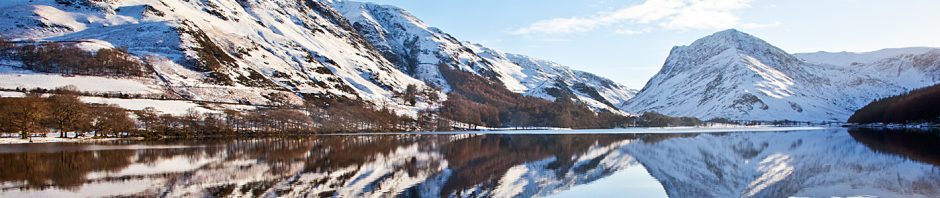
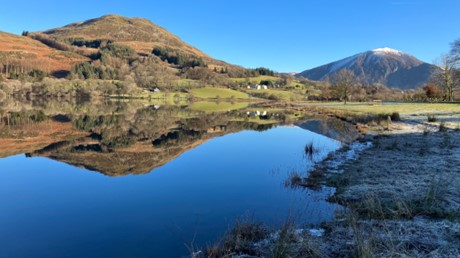
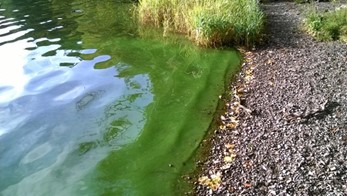
Maybe not as dramatically located as Wastwater down the coast, but Loweswater still has a wonderful, albeit softer, setting between the wooded slopes of Burbank Fell and Carling Knott on one side and the more open slopes of Low Fell and Darling Fell on the other. Rather than flowing out directly to the Cumbrian coast, the Dub Beck outlet flows inland down to Crummock Water to form part of the short River Cocker which joins the River Derwent at Cockermouth and thence to the sea at Workington. It’s a small lake by Cumbrian standards, but like most others (including its near neighbours Crummock Water and Buttermere round the corner), it has a split personality in that, whilst it’s a well-mixed, homogeneous body of water for most of the year, in summer it stratifies into two distinct layers. This leads to a deterioration in water quality – this is caused by algae that have settled to the bottom and then decompose using up the water’s dissolved oxygen. It’s quite complex as this process can then recycle nutrients which, added to fresh nutrients coming from the catchment, exacerbate growth of algae (see photo below) through a positive feedback mechanism.
I got involved with Loweswater in 2007 when the University of Lancaster began its research project “Understanding and Acting in Loweswater – a Community Approach to Catchment Management”, but this soon became better known by the above title and its LCP acronym (suggested by a local resident as being more user-friendly). This project followed a pioneering initiative to improve the local environment led by the local farmers around the lake after the hard times brought about by the foot and mouth outbreak in 2001. Amongst many other achievements, this led to collaboration with the Centre for Ecology and Hydrology in Lancaster, who then became involved in the LCP along with the lead Social Science Department at Lancaster University.
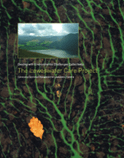
You can read all about this work in the short booklet (see left, click to view it). Thanks to the publicity put out by the university, the project became quite well-known for its community involvement and use of “citizen science” in mini projects carried out by locals. I was one of them and I looked into how well the local septic tanks were working and the contribution of household chemicals (particularly dishwasher tablets) to nutrient loads (something that I hadn’t thought I would be doing when I moved here).
This project finished in 2010 when the local community decided to try to maintain the momentum built up and continue the scientific work in some way. We were lucky that DEFRA’s “Catchment Restoration Fund” came along just at the right time in 2012. Our successful funding application gave us about £300k to work on a multi-faceted project which:
- worked with local farmers to reduce nutrient loads to the lake
- carried out some research into nutrient sources and mitigation techniques
- allowed us to monitor the lake’s water quality with our own equipment.
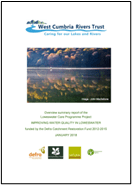
It was at this time that the LCP became part of the West Cumbria Rivers Trust and you can find more details of our continuing work on their website. We produced a short non-technical booklet describing the project (see right, click to view it), a full technical report and we have since published annual reports on our monitoring of the lake and its input becks. Since that project was completed (in 2015), there have been significant changes around the lake with many more cattle and fewer sheep. In 2022, the main feeder stream Dub Beck was re-naturalised from its canalised form and this should improve overall biodiversity and reduce nutrient inputs to the lake.
Climate change brought about by emissions of carbon dioxide (and other gases) to the atmosphere is raising the temperature of all water bodies (notably the oceans). In addition to the direct consequences of this on life in the lake, higher temperatures lead to a lengthening in the duration of lake stratification, which could have a negative impact on water quality. The other less-reported effect of increased CO2 emissions is aquatic acidification, which has decreased the pH of ocean waters by about 0.1 pH units (from 8.3 down to 8.2). This may not sound much, but pH is a logarithmic scale and this represents a 30% increase in acidity. Most Cumbrian lakes are quite soft (low hardness) and are less resilient to acidification than the oceans so the pH of Loweswater may have dropped by about 0.2 units to an average of 7.4. The consequnces of this pH shift are probably less severe than in the oceans as the pH of Loweswater can change by a whole unit within a few hours when algae start multiplying quickly.
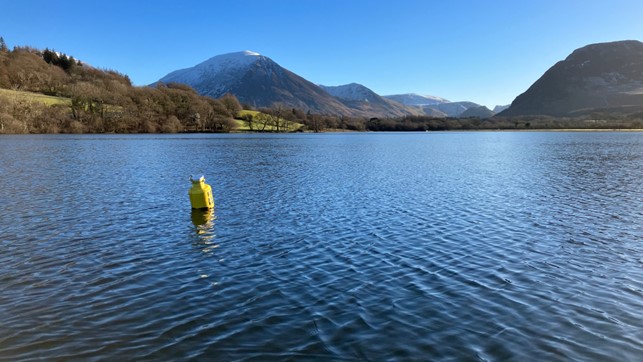
We have recently stopped monitoring the lake’s feeder becks, but are still monitoring the lake itself via the in-lake sensor (see photo of small buoy housing the sensor) and taking samples every month to characterise changes in the algal population. Under the EU Water Framework Directive (still operative despite Brexit), Loweswater was given a relaxed timeframe to improve its classification from “moderate” to “good” ecological status, but this deadline (2027) is now not far off. As touched on in the opening paragraph above, the main issue here is the loss of oxygen in the lake’s bottom layer in summer so we are now looking into this further to try to understand why about 11 tonne of oxygen is being used up every year. This quantity is more than the resident human population of Loweswater take in annually.
Over the years, I have written a few pieces on Loweswater for the local Link magazine and these can be accessed from the list below.
a 2020 review of work on Loweswater here.
a 2021 piece on acidification in natural waters here.
a 2022 wider article on carbon compounds in the environment here.
a 2023 article on there future of the lakes in the valley here.
a 2023 article on the impact of climate change on lakes here.
a 2023 non-water article about energy use here.
a 2024 article comparing Buttermere and Loweswater lakes here.
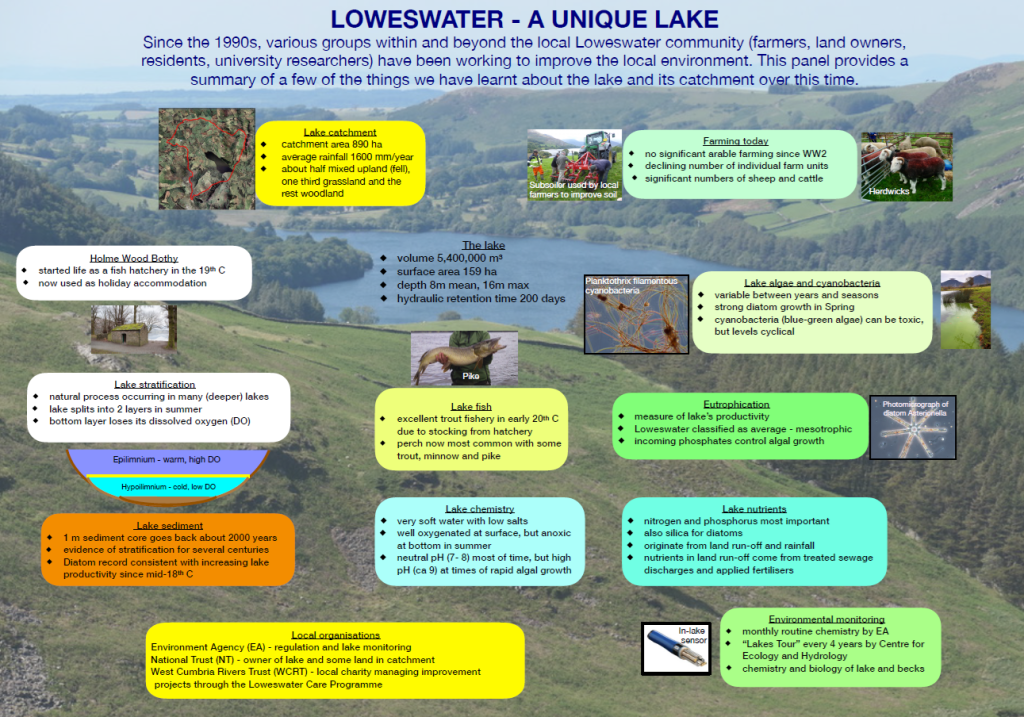
Finally, here’s a summary graphic of some of the lake info we have gathered in recent years. Click the graphic to open or download as pdf file.
Leslie Webb, LCP Steering Group, August 2024.
 The Melbreak Communities